Achieving Workplace Excellence Certification with Veteran-Friendly Practices
Achieving Workplace Excellence Certification with Veteran-Friendly Practices 8 min. read. Want to create a truly veteran-friendly workplace? Here’s how to get certified and support your veteran employees: Set up dedicated veteran recruitment Create smooth transition programs Help translate military skills to civilian jobs Get leadership buy-in Establish clear company values Form veteran resource groups Offer […]
Achieving Workplace Excellence Certification with Veteran-Friendly Practices
8 min. read.
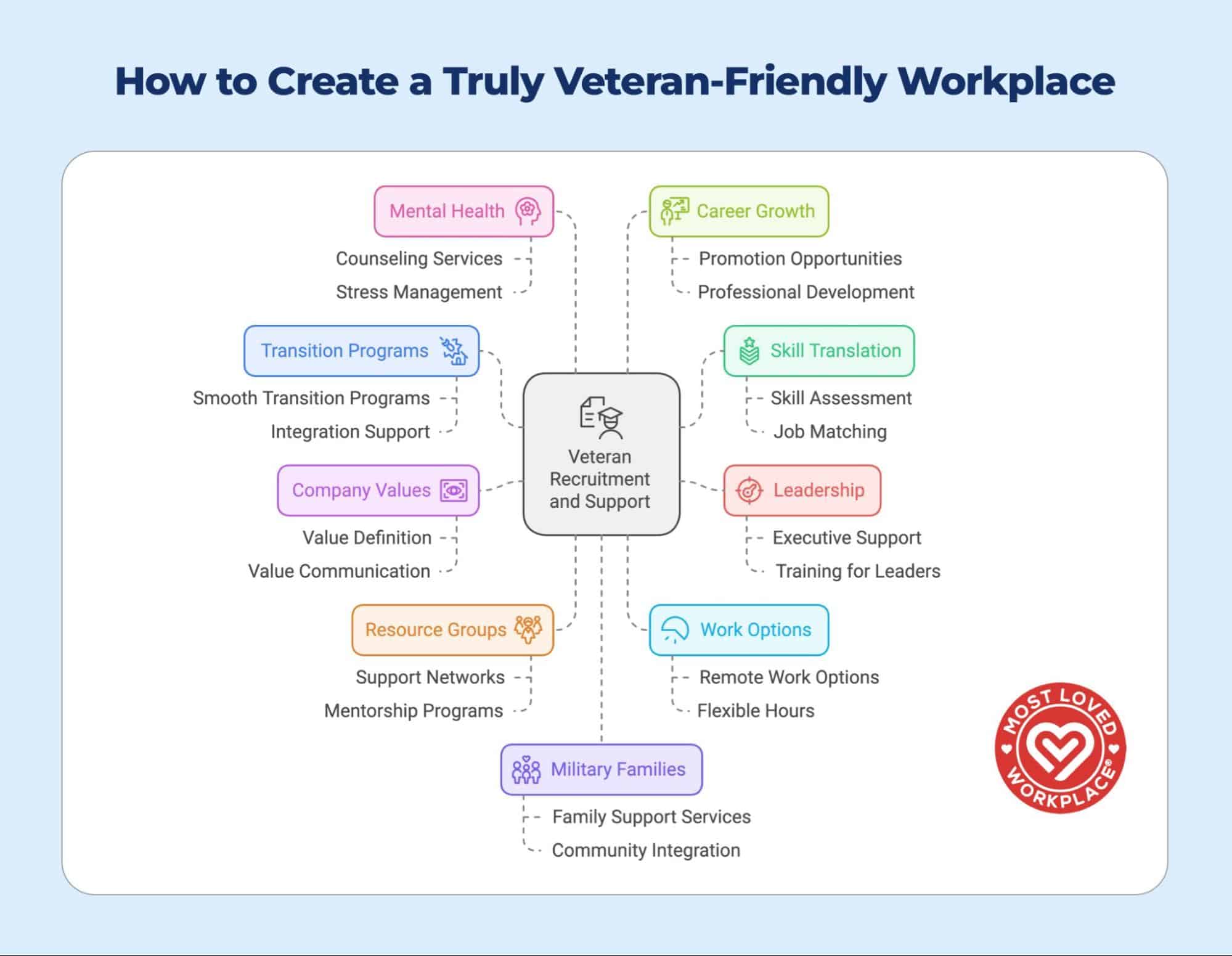
Want to create a truly veteran-friendly workplace? Here’s how to get certified and support your veteran employees:
- Set up dedicated veteran recruitment
- Create smooth transition programs
- Help translate military skills to civilian jobs
- Get leadership buy-in
- Establish clear company values
- Form veteran resource groups
- Offer flexible work options
- Provide mental health support
- Create career growth opportunities
- Support military families
- Offer ongoing education
- Build a veteran community
- Recognize veteran achievements
Key steps for certification:
- • Conduct a workplace review
- • Implement veteran support policies
- • Train managers on veteran needs
To track success:
- • Monitor veteran hiring and retention rates
- • Measure veteran job performance
- • Get regular feedback from veteran staff
Keep improving by:
- • Updating policies annually
- • Providing ongoing manager training
- • Staying current on veteran employment laws
By following these practices, you’ll create an environment where veterans thrive and earn recognition as a top veteran employer.
How Training Your Non-Veteran Workforce Can Create a More Veteran-Inclusive Workplace
What Makes a Top MostLovedWorkplace® for Veterans
Creating a veteran-friendly workplace isn’t just about hiring ex-military. It’s about building an environment that supports veterans and taps into their unique skills. Here’s what sets apart the best workplaces for vets:
Getting Certified
To be certified as a top workplace for veterans, companies need to show they’re serious about supporting former service members. Here’s what it takes:
- Dedicated Veteran Recruitment
You need a team focused on bringing vets on board. Booz Allen Hamilton, for example, has a “Help or Hire” policy. Their recruiters either hire vets and military spouses or help them find jobs elsewhere.
- Smooth Transition
A good onboarding program is key. Why? Because 44% of vets quit their first civilian job within a year. Yikes!
- Skills Translation
The military and civilian worlds speak different languages. Top companies help vets translate their skills. AAR and J.B. Hunt Transport, for instance, offer training to help vets shift gears into civilian careers.
- Leadership Buy-In
The big bosses need to be on board. Without support from the top, veteran-friendly practices won’t stick.
- Clear Values
Companies need to spell out their values and show how they line up with military values. As Lida Citroën, a veteran employment expert, puts it:
“Veterans often tell me that they ‘look to work for a company that has a set of values I can ascribe to.'”
- Veteran Groups
Setting up veteran resource groups gives former service members a place to connect, share resources, and network.
Supporting Military Personnel
It’s not just about hiring vets. It’s about supporting them once they’re on board. Here’s how top companies do it:
- Flexible Work
Vets often need time for VA appointments and counseling. Good companies offer flexible schedules and paid time off to accommodate this. It’s crucial, given that 11-20% of vets deal with PTSD each year, compared to less than 4% of civilians.
- Mental Health Support
Top workplaces offer employee assistance programs and insurance that covers mental health services.
- Career Growth
Many vets leave their first civilian job because they can’t move up. Great companies offer clear career paths and coaching tailored for veterans.
- Family Support
Military spouses face an 18% unemployment rate. The best companies extend support to the whole military family.
- Ongoing Education
Top workplaces train supervisors and team leaders about veteran issues and resources. This builds understanding across the company.
- Community Building
Creating opportunities for vets to connect within the company is key. This might include social events or family-friendly activities.
- Recognition
The best companies celebrate Veterans Day and highlight vet employees’ achievements. It’s all about building a culture that values veterans’ contributions.
Building Support Systems for Veterans
Creating a workplace that supports veterans goes beyond hiring. It’s about building systems that help them thrive in civilian careers. Let’s look at three key strategies for supporting veterans in your organization.
Setting Up Veteran Groups
Veteran Employee Resource Groups (VERGs) help veterans connect and support each other as they transition to civilian work life.
Here’s how to set up a VERG:
- Find interested people
- Set clear goals
- Get leadership support
- Create a structure
- Make it inclusive
Angie Carpenter from the University of North Dakota (UND) says: “The more I talk about starting the group to my colleagues, the more people are identifying as military-affiliated.” This can lead to a thriving VERG that really helps veterans in your workplace.
Military to Civilian Skills Guide
Veterans often struggle to translate their military skills into civilian terms. A Military to Civilian Skills Guide can help both veterans and hiring managers.
Here’s how to make one:
- List common military skills
- Match them to civilian jobs
- Highlight soft skills
- Add industry-specific examples
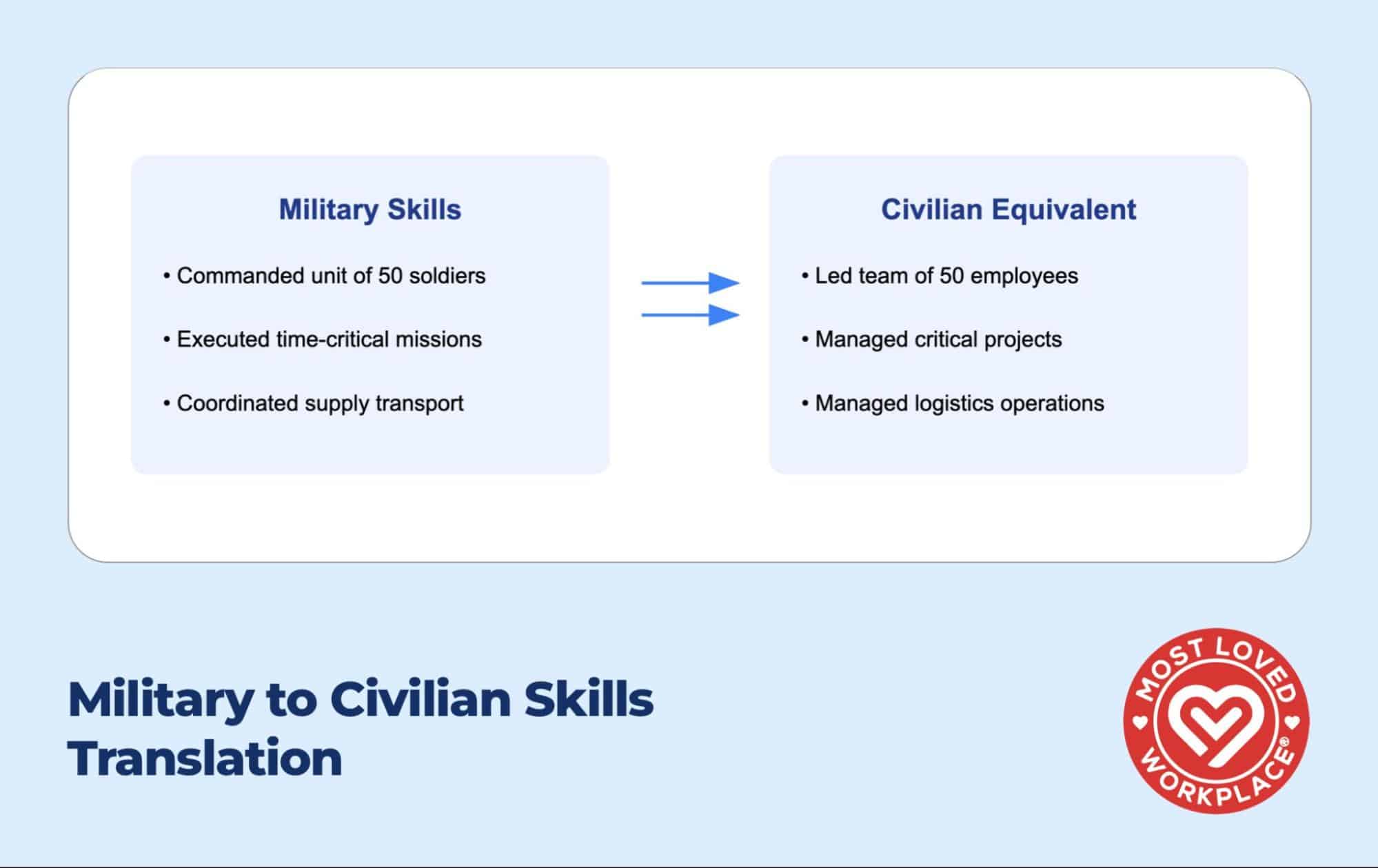
|
Military Skill
|
Civilian Equivalent
|
|---|---|
|
Commanded a unit of 50 soldiers
|
Led a team of 50 employees
|
|
Executed missions with tight deadlines
|
Managed time-sensitive projects
|
|
Coordinated supply transportation
|
Managed logistics operations
|
Don’t forget soft skills:
|
Military Soft Skill
|
Civilian Application
|
|---|---|
|
Adaptability
|
Thriving in fast-paced environments
|
|
Teamwork
|
Collaborating in cross-functional teams
|
|
Problem-solving
|
Developing solutions to complex challenges
|
Veteran Mentoring
A good mentoring program can boost morale and keep veterans engaged. The Department of Veterans Affairs found it’s the most wanted program for veterans transitioning to civilian life.
To create a strong mentoring program:
- Match veterans with experienced employees
- Set clear goals
- Train the mentors
- Create a structured program
- Measure how well it’s working
Susan Feland from AcademyWomen says: “Mentoring can help create more connective networks for veterans while transitioning their military strengths to workplace success.”
Demonstrate concrete proof that you’re the real deal – the one that star applicants would love to work for!
Key Steps for Certification
Want to be a certified veteran-friendly workplace? It’s not just about good intentions. You need to take real action. Here’s what you need to do:
Workplace Review
First, take a hard look at where you stand:
- Check your current practices for hiring, onboarding, and keeping veteran employees.
- Find the gaps in how you support veteran employees.
- See how you stack up against companies that are already certified as veteran-friendly.
Here’s a tip: Use the Most Loved Workplace Index® survey. It’s a great way to see how your employees feel, especially your veteran staff.
Veteran Support Rules
Now, let’s put some real support in place for your veterans. Here are the key rules:
|
Rule
|
What It Means
|
How to Do It
|
|---|---|---|
|
Flexible Scheduling
|
Make room for VA appointments and counseling
|
Give 2 hours of flex time each week for appointments
|
|
Military Leave
|
Keep jobs safe during deployment or training
|
Promise to hold their job for up to 5 years of service
|
|
Skills Translation
|
Help vets use their military skills in civilian jobs
|
Create a guide that shows how military skills fit civilian roles
|
|
Career Growth
|
Show clear paths for moving up
|
Set up mentoring programs that pair vets with senior leaders
|
These aren’t just nice extras. You NEED these for certification. More importantly, they show you really support your veteran employees.
Manager Training
Your managers are key to supporting veteran employees. Here’s how to get them ready:
- Teach them about military culture and the challenges vets often face.
- Show them how to spot and use the unique skills veterans bring.
- Make sure they know about all the veteran support programs you offer.
Susan Feland from AcademyWomen puts it well:
“Managers who understand the veteran experience can better support their transition and leverage their unique skills.”
Put a solid training program in place. For example, Booz Allen Hamilton makes all hiring managers take a “Military 101” course. It helps them understand and support veteran employees better.
Tracking Results
Want to know if your veteran support programs are working? You need to track them. Here’s how to measure success and get feedback to make your initiatives even better.
Hiring and Keeping Veterans
Tracking how many veterans you hire and keep is key. Here’s what to look at:
- Hiring Metrics
Keep an eye on these numbers:
|
Metric
|
What It Means
|
|---|---|
|
Veterans hired
|
Total number of vets you've brought on
|
|
Percentage of vet hires
|
How many of your new hires are vets
|
|
How far vets get
|
Do vets make it through your hiring process?
|
- Retention Rates
This is where many companies drop the ball. Track:
- • How long vets stay compared to other employees
- • How long vets stick around on average
- • How often vets leave compared to others
Here’s a tip: Compare veteran retention to similar employees. It helps justify the resources you’re spending on hiring vets.
- Performance Metrics
It’s not just about numbers. Quality matters too. Look at:
- • How well vets perform in their roles
- • How quickly vets move up in the company
- • How productive vets are in their jobs
Real-world example: Proseal America, a food packaging company, found that vets moved up faster. Within a year, vet hires zoomed through their four-level system for field service techs. That’s a higher return on investment.
Getting Input from Staff
To really know if your vet programs are working, you need to hear from the people involved. Here’s how:
- Regular Surveys
Do surveys every 3-6 months. Ask about:
- • How happy vets are in their jobs
- • If support programs are helping
- • What could be better at work
- Focus Groups
Get small groups together to chat. Include:
- • Vet employees
- • Managers who work with vets
- • HR folks involved in vet programs
You’ll get deeper insights into what vets experience day-to-day.
- One-on-One Check-ins
Set up regular chats between:
- • Vets and their mentors
- • HR reps and vet staff
These personal talks can uncover issues that might not come up in bigger groups.
- Anonymous Feedback
Set up a way for people to give feedback without using their names. It can help you get honest input about touchy subjects.
Stacie Furst-Holloway, Associate Professor of Psychology at UC, puts it well:
“We can focus on hiring, but if we don’t tie that to the bigger picture in terms of retention as well, then we’re missing half the picture.”
Keeping Standards High
Creating a veteran-friendly workplace isn’t a one-and-done deal. It takes ongoing effort and tweaks to keep things running smoothly. Here’s how to keep your veteran support game strong:
Regular Policy Updates
You’ve got to keep your policies fresh. Here’s the playbook:
- Annual Check-Ups
Set a yearly date to review your policies. It’s like a health check-up for your veteran support system.
- Ask Your Vets
Get the scoop straight from your veteran employees. Their insights are gold for spotting what needs fixing.
- Stay in the Loop
Keep an eye on new laws affecting vets, like changes to the Americans with Disabilities Act (ADA). You don’t want to get caught off-guard.
- Peek at the Competition
See what other companies are doing right for vets. It might spark some ideas for your own workplace.
Here’s a quick look at how to keep your policies up-to-date:
|
Step
|
Action
|
How Often?
|
|---|---|---|
|
1
|
Survey veteran employees
|
Every 3 months
|
|
2
|
Review feedback
|
Every 3 months
|
|
3
|
Check for new best practices and laws
|
Twice a year
|
|
4
|
Update policies
|
Once a year
|
|
5
|
Tell everyone about the changes
|
As needed
|
The end game? A workplace where vets feel like they belong, long-term. As Sarah Peiker from Orion Talent puts it:
“Choose one, and make it amazing! Then move on to the next retention strategy. Your veteran employees will be proud to call your company home.”
Manager Growth
Your managers are key players in supporting vets. Keep them on their toes with ongoing training:
- Military 101
Create a crash course for all managers. Cover the basics of military life, common vet challenges, and how to tap into their unique skills.
- Regular Skill-Ups
Host quarterly sessions on hot topics like PTSD awareness or translating military skills to civilian jobs.
- Info at Their Fingertips
Give managers easy access to vet support info, including ADA accommodation guidelines.
- Buddy System
Pair up seasoned managers with newbies. Sometimes, the best learning happens peer-to-peer.
Here’s what a solid manager training plan might look like:
|
Training Type
|
How Often?
|
What's Covered?
|
|---|---|---|
|
New Manager Course
|
Once
|
Military culture, veteran challenges, skill translation
|
|
Skill-Up Workshop
|
Every 3 months
|
PTSD awareness, veteran career development, legal updates
|
|
Manager Mentoring
|
Monthly
|
One-on-one chats with experienced managers
|
|
Resource Updates
|
As needed
|
New support programs, policy changes, success stories
|
Investing in your managers’ vet support skills isn’t just good for vets – it’s good for everyone. As Ashley Jones from ClearedJobs.Net says:
“If your company takes care of veterans, they will take care of you.”
Keeping your veteran support game strong shows you’re serious about diversity, inclusion, and valuing military experience in the civilian world. By staying on top of your policies and helping your managers grow, you’re setting yourself up for long-term success in hiring and keeping vets.
Next Steps
You’ve learned about creating a veteran-friendly workplace. Now it’s time to act. Here’s how to get started:
Get Leadership Support
First, get your top executives on board. Without their backing, your veteran initiatives won’t go far.
Start a Veteran Employee Resource Group (ERG)
Set up an ERG to support your veteran employees. Cognosante‘s ConVERG is a great example. They focus on mentorship, recruitment, and community service for veterans.
Set Up Mentorship
Pair new veteran hires with experienced employees. EM Key Solutions does this through their EVOLVe workgroup, led by a marine veteran.
Improve Your Recruitment
Attend veteran career fairs, train recruiters on military resumes, and use veteran-friendly job descriptions. Focus on skills, not just years of experience.
LaSalle Network is a good example. They launched a Veteran Network to help 1,000 veterans find jobs and trained their recruiters to understand military resumes.
Offer Targeted Benefits
Think about benefits that address veterans’ specific needs:
- • Flexible schedules for VA appointments
- • Mental health support through Employee Assistance Programs
- • Extra leave for reservists’ training
Invest in Training
Educate your team:
- • Teach managers about military culture and veteran challenges
- • Help veterans apply their military skills to civilian jobs
- • Educate staff on supporting veterans with PTSD
Measure Your Progress
Keep an eye on key metrics:
- • Percentage of veteran hires
- • How long veterans stay with your company
- • Career growth of veteran employees
Get Involved in the Community
Show your commitment beyond the workplace. Brookshire Grocer Company, for example, takes 500 veterans on all-expenses-paid trips to Washington, D.C. through their Heroes Flight program.
Aim for Certification
Work towards becoming a certified Military-Friendly Employer, like Premise Health. This can help attract more veteran talent.
Keep Improving
Regularly review and update your veteran support policies. As Sarah Peiker from Orion Talent says:
“Choose one, and make it amazing! Then move on to the next retention strategy. Your veteran employees will be proud to call your company home.”
FAQs
How can companies create a welcoming culture for veterans?
Creating a welcoming culture for veterans isn’t just about hiring them. It’s about making them feel valued and understood. Here’s how companies can do it:
Set up a Veteran Employee Resource Group (ERG)
A Veteran ERG can make a big difference. Here’s a quick guide:
- Get the bosses on board
You need support from the top. Make sure executives are backing your ERG.
- Know what you want to achieve
Set clear goals. What do you want the ERG to do?
- Find your people
Reach out to veteran employees. Get them involved.
- Plan regular meetups
Schedule meetings and events. Keep the momentum going.
- Give them what they need
Provide resources and support to help the ERG thrive.
Michelle Tillis Lederman, an expert on workplace culture, puts it this way:
“Create a Veteran Employee Resource Group (ERG) A Veteran ERG can significantly enhance the workplace experience for former service members: Establish a formal Veteran ERG with executive sponsorship.”
Offer benefits that matter to veterans
Think about what veterans really need:
- Flexible schedules for VA appointments
- Help with military childcare
- Training to boost their skills
- Support for military families
- Access to therapists who understand military life
Set up mentorship programs
Pair veterans with experienced employees. This helps them navigate the civilian workplace and grow their careers.
Teach everyone about military culture
Help non-veteran employees understand military culture and the unique skills veterans bring. It bridges the gap between military and civilian work life.
Show appreciation for military service
Celebrate Veterans Day and other military occasions. It shows you value your veteran employees’ service and sacrifices.

Building a Thriving Workplace Culture!
Discover how to leverage the right technology and implement a proactive strategy that cultivates talent and facilitates team collaboration.
Take the next step on your employer brand
Three ways to move from reading to results. Pick what fits your stage.
Run your CertCheck report
See how AI systems currently describe your employer brand to candidates.
Get My Free ReportApply for certification
Measure your organization on the Love of Workplace Index® and join 1,800+ certified companies.
Start ApplicationTalk to a Strategic Advisor
Walk through your Employer Branding & Certification Insights report with a specialist.
Keep reading
When a Candidate Asks AI About You, What Do They Find?
When a Candidate Asks AI About You, What Do They Find? Here’s what’s changed in how candidates research employers, and it’s happening faster than most HR teams realize. Two years ago, a candidate researching your company would open a browser and search. They’d look at your careers page, check Glassdoor, maybe find a LinkedIn review […]
What the World’s Most Loved Workplaces Actually Do to Win the War for Talent
What the World’s Most Loved Workplaces Actually Do to Win the War for Talent There are 1.7 job openings for every unemployed worker in the United States right now. ManpowerGroup’s 2026 Talent Shortage Survey found that 75 percent of employers globally report difficulty filling roles, the highest level in over a decade. Most companies respond […]
A Breakdown of Most Loved Workplace® Certification ROI
Blog A Breakdown of Most Loved Workplace® Certification ROI Louis Carter April 29, 2026 What is the return on investment for Most Loved Workplace® certification? Most Loved Workplace® certification delivers measurable return across three categories: recruiting efficiency, employee retention, and employer brand credibility. The investment does not produce abstract goodwill. It produces verifiable proof that […]