

Hiring transparency isn’t a recruiting trend. It’s a trust decision. Candidates are deciding whether your organization is safe, competent, and worth the emotional investment long before you decide whether they’re qualified.
The problem is that many hiring processes are designed for internal convenience, not external clarity. The result is a familiar pattern: candidates start hopeful, then wait in silence, then disappear. Leaders call it “a competitive market.” Candidates call it “risk.”
Hiring process transparency is how you remove that risk. Not by overpromising. Not by publishing a manifesto. By telling the truth early, and running a process you can explain in plain language.
What Hiring Process Transparency Actually Means
Transparency in hiring means candidates can answer the basics quickly: what the role is, what success looks like, what the process involves, how decisions are made, and when they’ll hear from you. It means your hiring experience feels consistent, not improvised.
It also means the story in your job post matches the job people actually do. Candidates don’t expect perfection. They expect alignment. When the reality changes midstream—new requirements, extra rounds, shifting compensation—trust drops fast and rarely comes back.
Transparency isn’t giving candidates “everything.” It’s giving them enough to self-assess fit without guesswork. That’s what reduces mismatches, accelerates decisions, and protects your reputation in the talent market.
Glassdoor has long reported that transparency matters deeply to job seekers, including a widely cited survey finding that 96% say it’s important to work for a company that embraces transparency.
Why Candidates Don’t Assume The Best Anymore
In the past, candidates tolerated ambiguity because information was scarce. Today, information is abundant and often contradictory. A career page says “people-first.” A review site says “burnout.” A recruiter says “fast process.” A friend says “seven rounds.”
So when your hiring process is vague, candidates don’t fill in the gaps with optimism. They fill them with caution. Silence becomes a signal. Unclear steps feel like disorganization. Surprise assignments feel like hidden expectations.
Transparency doesn’t just improve candidate experience. It changes the emotional posture of the process. When people feel informed, they show up with more confidence, clarity, and goodwill. When they feel managed in the dark, they hedge.
That’s why transparency is not a communications task. It is a leadership behavior expressed through recruiting.
The Five Things Candidates Want To Understand Early
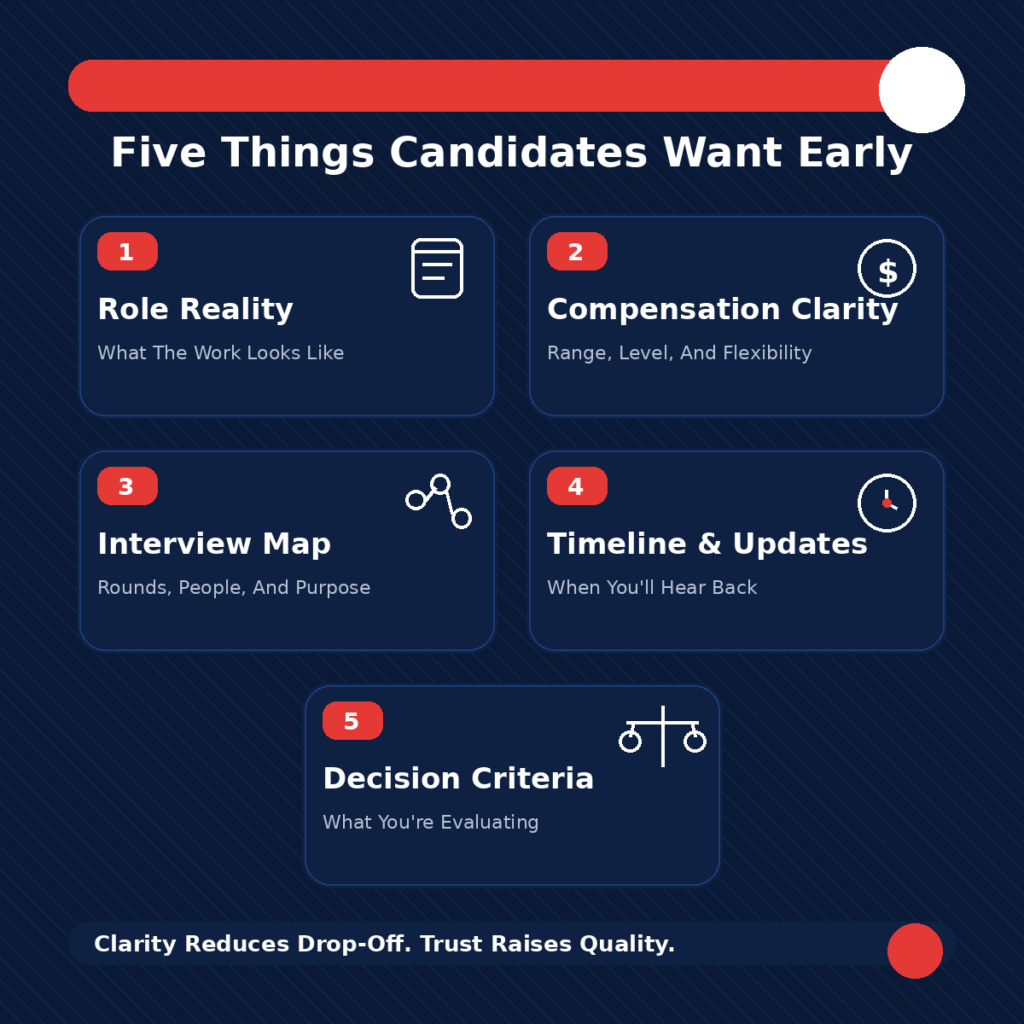
First, candidates want role reality. They want to understand what the work actually looks like in a typical week, what decisions they’ll own, and what “good” means in your environment. Generic job descriptions create generic applicants. Specific roles attract serious candidates.
Second, they want compensation clarity. Candidates don’t need exact offers on Day One, but they do need a range, a level, and a sense of what’s fixed versus flexible. When pay is hidden, candidates assume either inequity or gamesmanship. Neither assumption helps you.
Glassdoor’s more recent work also shows pay transparency is strongly associated with inclusion and trust, with a large share of job seekers saying pay-band transparency matters to them.
Third, they want an interview map. How many rounds are there. What each round is for. Who they’ll meet. Whether there’s an assignment. Whether references are required. The map does not need to be elaborate. It needs to be accurate.
Fourth, they want timeline and communication rhythm. When should they expect updates. What happens if the timeline slips. Who owns the next step. Uncertainty is the biggest driver of candidate drop-off, and it’s usually avoidable.
Fifth, they want decision criteria. Candidates can handle a “no” when the process felt fair. They struggle when decisions feel subjective, inconsistent, or unexplained. Fairness isn’t only an ethics issue. It’s a trust issue.
Where Hiring Processes Break Trust
Most hiring processes don’t break in dramatic ways. They erode trust through small, repeated signals that say, “We’re not organized,” or “We don’t respect your time,” or “We’re making this up as we go.”
A role is posted, then revised midstream. An interview panel asks overlapping questions, because no one aligned on what they’re evaluating. An assignment appears late with no context. A candidate waits two weeks for an update and gets a template rejection.
These are not just “candidate experience problems.” They are culture signals. If the process is unclear, candidates assume the organization is unclear. If communication is inconsistent, candidates assume leadership is inconsistent.
And when candidates disappear, it’s easy to blame the market. But often, the market is responding to your process.
SHRM has covered candidate ghosting and repeatedly emphasizes that breakdowns in communication are a primary driver of it.
What High-Trust Transparency Looks Like In Practice
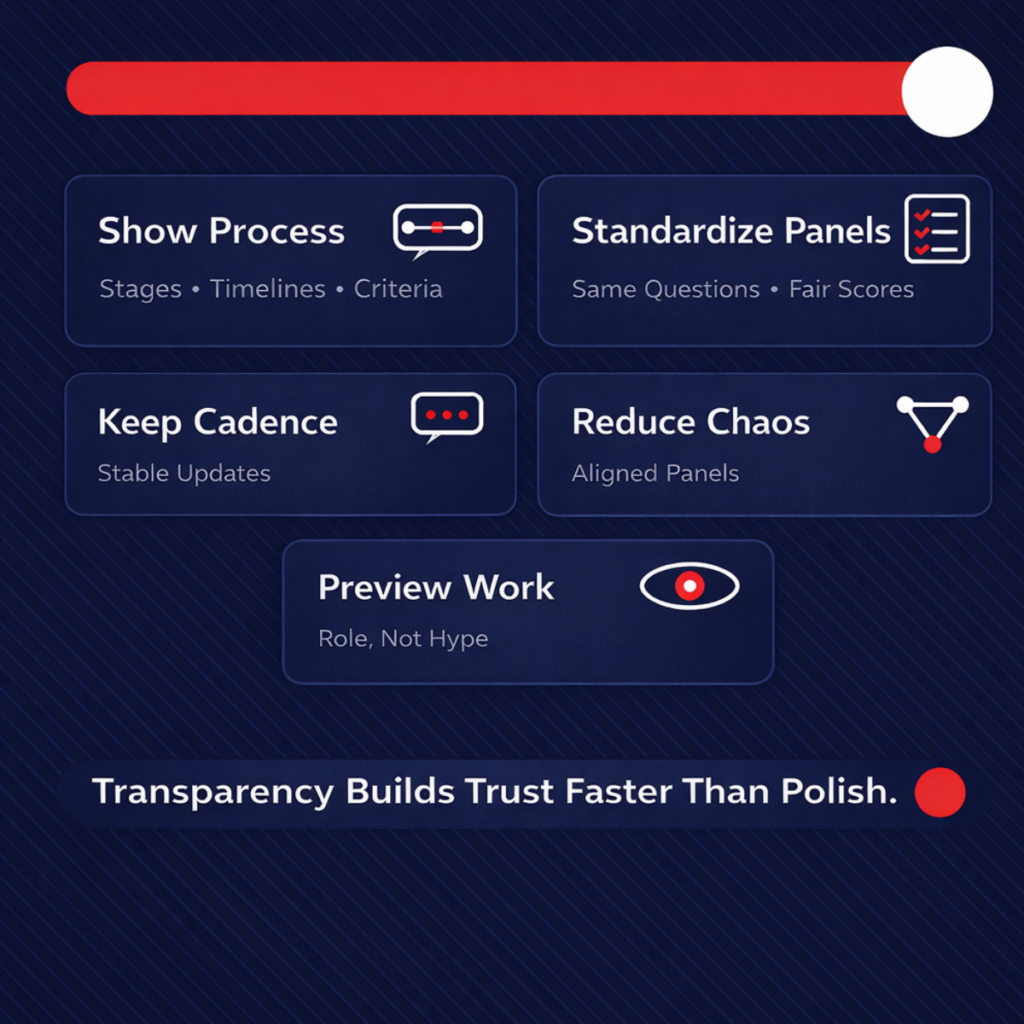
Transparent hiring is not about adding more steps. It’s about making the existing steps visible and coherent. It is the difference between “We’ll be in touch” and “You’ll hear from us by Friday, even if it’s just an update.”
A simple “How We Hire” page is one of the highest-leverage moves you can make. Candidates should be able to see the stages, approximate timelines, and what you evaluate at each stage. If your process varies by role, say so and explain why.
Transparency also means standardization where it matters. Unstructured interviews create inconsistent experiences and invite bias, while structured interviews reduce noise and improve fairness. Harvard Business Review has highlighted practical ways organizations reduce bias, including standardizing interviews and using consistent questions.
This isn’t about making hiring robotic. It’s about reducing randomness. Candidates can feel when an interview is thoughtful and aligned. They can also feel when it’s a series of disconnected conversations.
Communication is the other pillar. Transparency requires a cadence. If you can’t update every candidate individually, build systems that allow candidates to see progress. Even a simple portal status update reduces uncertainty. If your team is delayed, communicate the delay. Silence is the fastest way to lose trust.
Finally, transparency means showing the work. Instead of asking candidates to imagine the job, let them preview it. Share a real sample project, explain how decisions are made, or offer a short “meet the team” overview so candidates understand context. Reality builds trust faster than polish.
Best Career Pages For Hiring Transparency
The best career pages don’t feel like advertising. They feel like clarity. They explain the process in a way that reduces anxiety and helps candidates self-select. They also communicate respect by making the path visible.
Google is a strong example of process transparency because it educates candidates on what to expect, how interviews work, and how decisions are made. It treats the candidate experience like a system, not a guessing game.
Atlassian’s candidate resources are notable for practical preparation and clear expectations. The tone is direct, and the structure helps candidates understand what the company evaluates without pretending there’s one “perfect” way to interview.
HubSpot has long approached hiring like a mutual evaluation, with candidate-facing clarity around values, ways of working, and what fit looks like in practice. Candidates can understand the culture without being sold a fantasy.
Netflix’s careers and culture ecosystem is a different style, but it is transparent in a way many companies avoid. It communicates expectations directly, including what high performance means in their environment. That clarity isn’t for everyone, which is precisely the point.
These examples aren’t perfect templates. They are reminders that candidates want orientation, not slogans. They want to know what happens next, and what kind of organization they’re walking into.
Transparency Without Oversharing
Some leaders avoid transparency because they worry it creates legal risk or locks them into promises. That fear is understandable, but it is often solvable with better language.
You can publish salary ranges without guaranteeing offers. You can publish timelines with the caveat that roles vary. You can describe interview stages while noting that specialized roles may require additional steps. You can explain evaluation criteria without disclosing internal deliberations.
The goal is not certainty. The goal is predictability. Candidates don’t need to control the process. They need to understand it.
If your hiring team can’t explain your process in three minutes, candidates will feel that confusion. Transparent hiring often begins as an internal exercise: align stages, define criteria, standardize communication, and then publish the truth.
The MLW Perspective: Hiring Transparency Is Culture, Not Marketing
At Most Loved Workplace, we see the hiring process as the first cultural experience. It is where trust begins or fractures. And it is often where organizations unintentionally communicate the opposite of what they claim.
A culture that values respect does not run a process that wastes time. A culture that values belonging does not run a process that leaves candidates guessing. A culture that values excellence does not improvise steps and call it “rigor.”
Transparency is an emotional signal. It tells candidates, “You will be treated like a person here.” That message matters even for candidates you don’t hire, because they still become storytellers in the market.
When leaders design hiring with transparency, they reduce early turnover, improve candidate fit, and strengthen employer brand credibility. More importantly, they begin the employment relationship with trust instead of suspicion.
MLW-Certified Companies Transparent Hiring Process
Conduent
Conduent is a strong example of a scale organization that reinforces clarity through consistent communication rhythms, manager development, and a “one team” operating model that reduces confusion across a distributed workforce.
First Watch
First Watch’s culture emphasizes listening and recognition shows how trust is built through visible leadership presence. That same “we hear you” discipline is the mindset that makes hiring processes feel human and clear.
MINT Dentistry
MINT’s rise on the Most Loved Workplaces list reflects how employer brand and experience connect. When culture improves, candidates feel it first through messaging clarity and consistent follow-through.
Synopsys Inc.
Synopsys reinforces inclusion and belonging through visible programs and leadership behaviors. In hiring, that kind of consistency shows up as clearer expectations and stronger candidate trust signals.
FAQs
What Is Hiring Process Transparency?
Hiring process transparency is the practice of making roles, steps, timelines, and decision criteria clear to candidates. It reduces uncertainty by telling candidates what to expect and how decisions are made.
Does Transparency Mean Sharing Everything?
No. Transparency means sharing enough truth to reduce guesswork. You can provide ranges, stages, and timelines without guaranteeing outcomes or exposing internal deliberations.
If you can, yes. Pay transparency improves trust and helps candidates self-assess fit earlier. If ranges vary, publish bands by level and clarify what influences placement.
How Do We Prevent Candidate Ghosting?
Ghosting is usually a communication failure. Set a communication cadence, share timelines, and send updates even when there is no decision yet. Candidates prefer delay with clarity over silence.
Do Structured Interviews Make Hiring Feel Cold?
Not when done well. Structured interviews create fairness and clarity. Candidates often experience them as more respectful because they can see the process is consistent, not arbitrary.
Can Transparency Improve Retention?
Yes, because realistic expectations reduce early mismatch. When candidates understand role reality, manager expectations, and ways of working upfront, they are less likely to feel blindsided after Day One.
Final Word: Clarity Is A Competitive Advantage
The organizations that win talent aren’t always the ones with the loudest employer brand. They’re the ones that feel trustworthy in the moments that matter. Hiring is one of those moments.
Transparent hiring does not require a redesign. It requires alignment. A clear process. Honest communication. And the discipline to treat candidates like adults who are making real decisions about their lives.
Do that, and you won’t just attract more applicants. You’ll attract better-fit applicants, with more confidence, and less fear. That’s what trust looks like before Day One.

Louis Carter is the founder and CEO of Best Practice Institute, Most Loved Workplace, and Results-Based Culture. Author of In Great Company, Change Champions Field Guide, and Best Practices in Talent Management, as well as a series of Leadership Development books. He is a trusted strategic advisor and coach to CEOs, CHROs, and leaders of mid-sized to F500 companies – enabling change and steering employer brand development together with highly effective teams, leaders, and organizations as a whole.


0 Comments