

High performers rarely leave with drama. They don’t announce a breaking point in a meeting or post a long goodbye note about “new adventures.” Most of the time, they simply get quieter, do what’s required, stop pushing for better, and then resign—often to the surprise of leaders who swear everything was “fine.”
That surprise is usually an illusion created by competence. High performers can keep delivering while emotionally detaching, because their skill covers the cracks for longer than most people can. The work still gets done, but the person disappears from the parts of culture that actually predict retention: voice, initiative, mentoring, candor, and belief in the future.
Quiet leaving isn’t about one bad day. It’s what happens when a high performer runs the same internal calculation for months: “If I keep caring this much, will anything change?” When the answer becomes no, silence starts—and silence is the early stage of exit.
Quiet Exits Start With A Predictable Shift
The earliest warning sign is not a dip in output. It’s a shift in participation. The person stops challenging weak decisions, stops offering improvements, and stops volunteering for the messy work that used to signal ownership. They’re still productive, but they’re no longer invested in the system.
This is the moment leaders often misread. Silence can look like agreement. Reduced visibility can look like focus. Less friction can look like alignment. But in many organizations, what you’re actually seeing is self-preservation: the person is conserving energy, reducing exposure, and quietly moving from “builder” to “survivor.”
Research on workplace silence consistently distinguishes between different reasons people withhold ideas, concerns, or suggestions—ranging from resignation (“nothing will change”) to fear (“it’s not safe”) to prosocial motives (“I’m protecting others”). The key leadership insight is simple: when silence becomes a pattern, it is rarely neutral. It is information about how safe and effective “voice” feels in your environment.
The Real Reasons High Performers Stop Trying
High performers don’t typically disengage because they suddenly became unmotivated. They disengage because the system made motivation expensive. Over time, effort stops feeling rewarded, safe, or rational. When the cost of caring rises and the payoff doesn’t, people begin to detach.
One common driver is the “high performer tax.” The strongest people get more work because they can handle it, while underperformance is tolerated “until we have time to address it.” That imbalance feels manageable at first, then quietly becomes a form of unfairness. High performers don’t always complain about it, because complaining often results in more work, not less.
Another driver is stalled growth. High performers don’t need a promotion every quarter, but they do need a sense of forward motion. When the work stops stretching them and the path ahead becomes vague, they start exploring options. They don’t always announce that exploration, because they’ve learned the organization may respond defensively—or not respond at all.
Recognition plays a role here too, not as vanity, but as fairness. When leaders take high performance for granted and pour attention into “fixing” low performance, the message is that excellence is expected but not valued. Harvard Business Review has warned that organizations often overlook high performers while focusing managerial energy elsewhere, which creates a predictable retention risk: the people driving results feel invisible, and invisibility erodes loyalty.
Why It Feels Sudden To Leaders (And Never Is)
Leaders often track what they can see: deliverables, deadlines, output. Quiet leaving lives in what leaders don’t measure: discretionary effort, optimism, and willingness to speak the truth early. High performers can maintain output while withdrawing from everything else—so leaders don’t notice until resignation lands.
This is why quiet exits are so expensive. By the time the resignation happens, the organization has already lost months of invisible value. The high performer likely stopped mentoring others. They likely stopped preventing problems before they happened. They likely stopped improving processes, raising risks, and sharing smarter approaches. Culture degraded quietly before headcount did.
And when that person leaves, the team doesn’t just lose one role. It loses a stabilizer. High performers often carry informal leadership, quality standards, and “how we do things here” norms that never show up on a job description. When they exit quietly, they often take those norms with them.
The Five Early Signals Your Best People Are Quietly Leaving
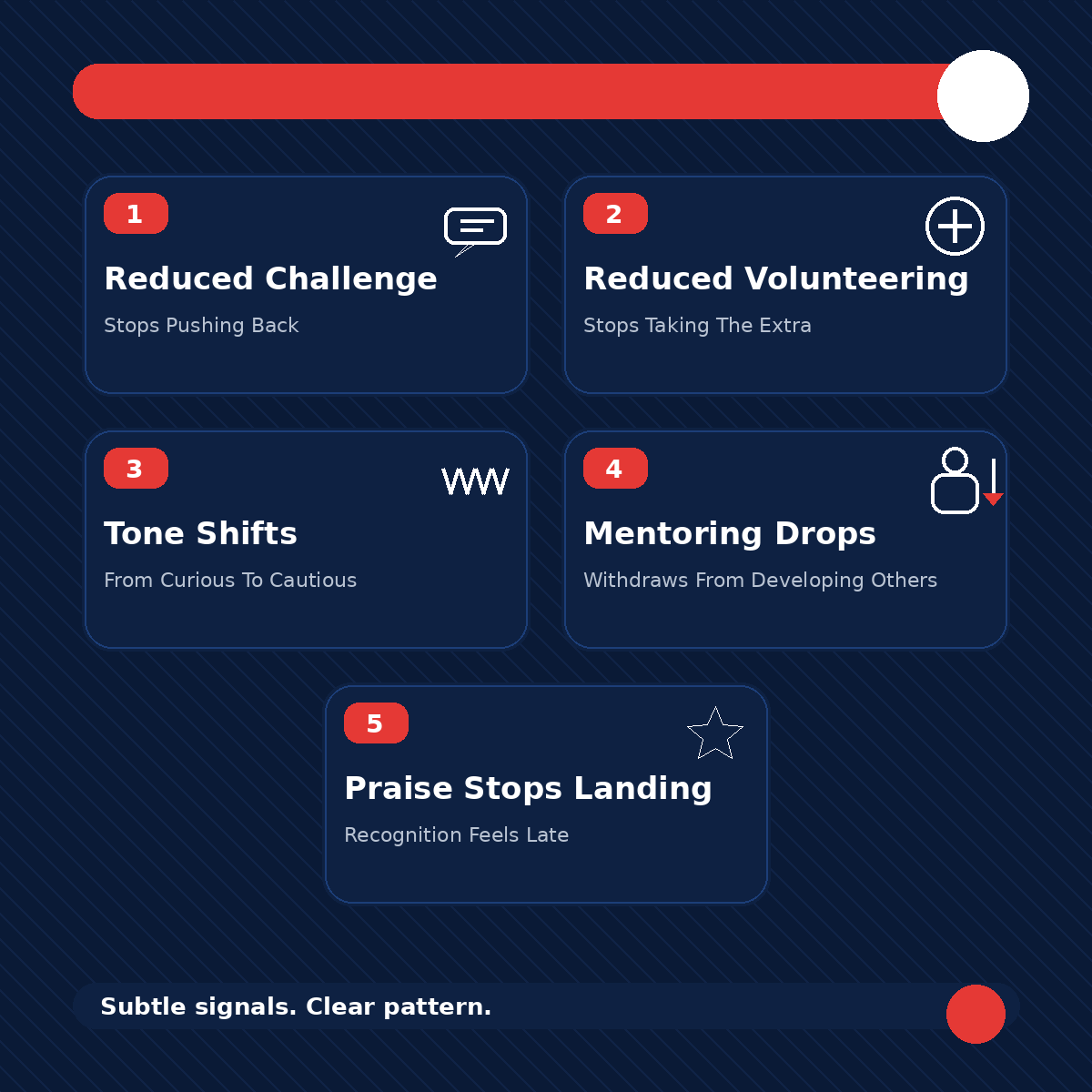
The signals aren’t dramatic. They’re subtle, consistent, and easy to rationalize away if you don’t want to see them. But once you learn the pattern, it becomes unmistakable.
The first signal is reduced challenge. High performers stop pushing back on weak decisions and stop offering alternative paths. They may still execute, but their candor becomes careful. This usually means they’ve decided speaking up costs more than it returns.
The second signal is reduced volunteering. They stop taking on the cross-functional work, the problem-solving, and the “extra” that used to make them stand out. Leaders sometimes interpret this as healthier boundaries, and sometimes it is. But when it comes with reduced voice and reduced energy, it often signals disengagement.
The third signal is a change in tone. They become shorter, less curious, less animated about the future. They stop asking questions about direction and start focusing only on what’s needed to get through the week. This is the shift from ownership to compliance.
The fourth signal is withdrawal from people development. High performers often mentor, coach, and help others succeed. When they stop, it can mean they’re conserving energy or protecting themselves from becoming even more responsible for outcomes they can’t control.
The fifth signal is lowered responsiveness to recognition or feedback. When someone is already mentally leaving, even well-intentioned praise can feel late. Leaders may try to “fix” it with compliments, but what the person needs is not flattery—it’s proof that the system will change.
How Leaders Stop Quiet Exits Before They Become Resignations
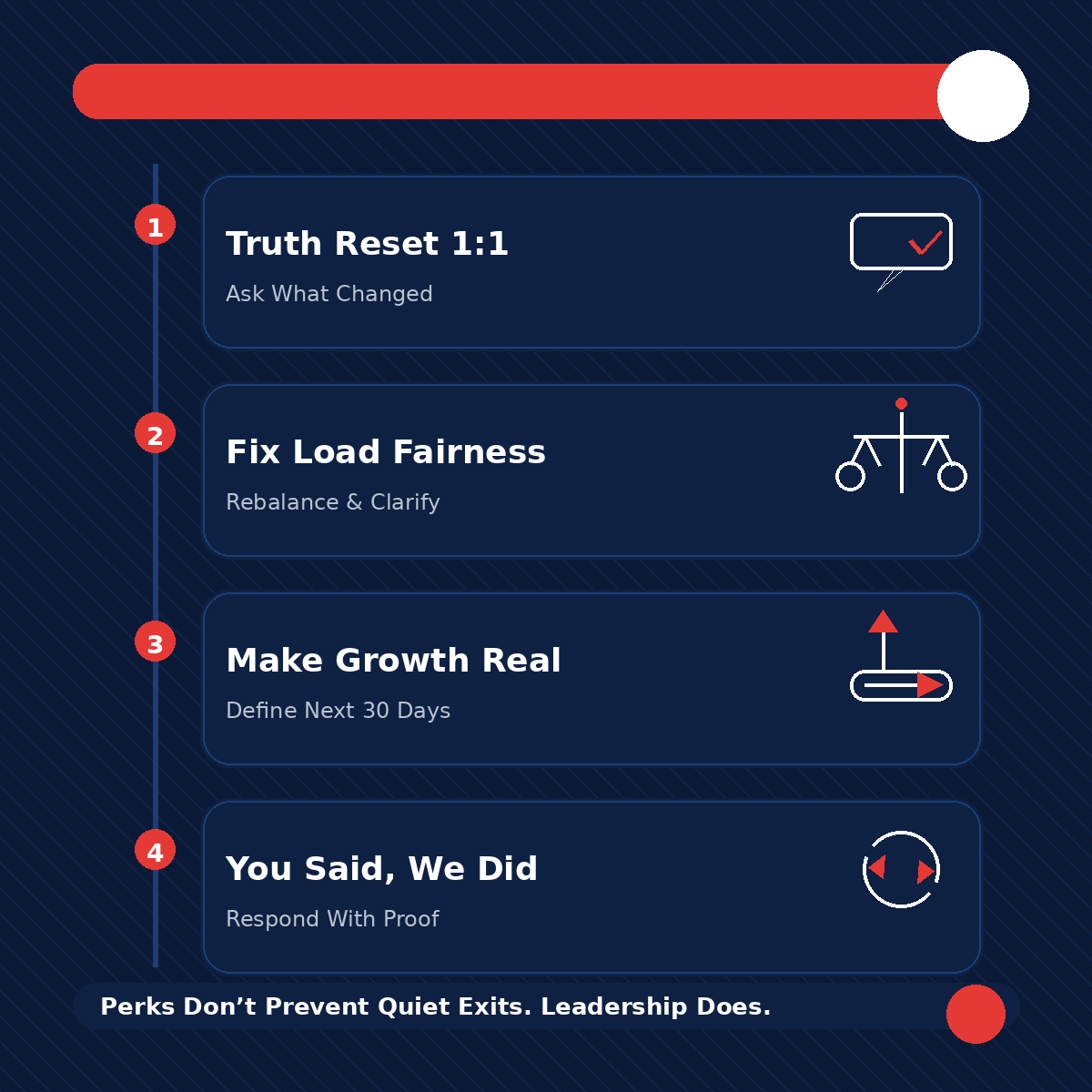
If you want to stop quiet leaving, perks won’t do it. A high performer leaving quietly is rarely leaving for snacks, swag, or a wellness app. They’re leaving because something foundational broke: fairness, growth, safety, or belief that their effort matters.
Start with a “truth reset” one-on-one. Not a casual check-in, and not a performance conversation. A truth reset is a focused conversation that asks what changed, what feels blocked, and what would make staying feel rational again. The point is not to convince them to stay. The point is to surface reality before the person decides it’s too late.
Then address load fairness directly. If your strongest people are repeatedly compensating for weak systems, the fix is not resilience training. It is rebalancing work, clarifying ownership, and removing recurring friction. This is the highest-leverage move most leaders avoid because it requires confronting underperformance and making tradeoffs.
Next, make growth specific in the next 30 days. Don’t promise “we’ll revisit in Q4.” Define one new scope area, one skill arc, or one meaningful project that signals forward motion. High performers stay when the future feels real, not theoretical.
Finally, build a visible “you said, we did” loop. Silence becomes exit when voice feels futile. The fastest way to reverse futility is to show response. That response doesn’t have to be perfect, but it must be timely, transparent, and connected to what the person raised. Even partial progress restores belief that speaking up is worth it.
Gallup’s research on retention and recognition reinforces a broader truth: people are more likely to stay when they feel seen, supported, and valued through consistent leadership behaviors—not occasional gestures. When recognition is meaningful and fair, it strengthens connection and retention over time.
The Most Loved Workplace Lens: Measure The Silence Before It Costs You
Quiet exits are rarely invisible. They’re just not captured in the metrics most organizations prioritize. Culture risk appears first in sentiment shifts, in open-text patterns, and in declining optimism about the future. When leaders only look at engagement scores or output, they miss the early signals that matter most.
In Most Loved Workplaces, we repeatedly see the same protective pattern: leaders treat voice as a system, not a mood. They normalize candor through frequent one-on-ones, transparent decision-making, and follow-through. And they reduce the high performer tax by building accountable teams, not hero cultures.
This is where culture measurement matters. When you track trust, belonging, respect, and future optimism—and you actually analyze open-text comments—you can detect the “futility” phase before the person reaches resignation. Quiet leaving becomes preventable when leaders can see emotional withdrawal early and respond with real changes.
Final Word: Quiet Leaving Is A Leadership Signal
High performers rarely leave because they stopped caring. They leave because caring stopped feeling safe, fair, or useful. They tried to improve things, didn’t see meaningful response, and learned the system would not change fast enough to justify continued effort.
If you want high performers to stay, treat silence as data. Watch for the shift from candor to compliance. Fix unfair load. Make growth real in the next 30 days. And build a culture where voice reliably leads to action, not to risk.
Quiet exits can be prevented—but only if leaders stop waiting for dramatic warning signs. The story is already being told. It’s just being told quietly.
FAQs
Why Do High Performers Leave Without Warning?
It usually isn’t without warning—it’s without visible warning. Withdrawal often begins months earlier as reduced voice, reduced initiative, and reduced optimism, while output remains steady because competence masks disengagement.
What Are The First Signs A Top Performer Is Disengaging?
The earliest signs are behavioral: less challenge to weak decisions, less volunteering for complex work, less mentoring, and a noticeable drop in curiosity or future-focused questions.
How Do You Retain High Performers Without Burning Them Out?
Remove the “high performer tax” by rebalancing workloads, addressing underperformance, and reducing recurring friction. Pair that with a clear, near-term growth step so forward motion is visible.
What Should Managers Do When A High Performer Goes Quiet?
Run a truth-reset one-on-one that asks what changed and what’s blocking them, then respond quickly with visible action. Silence often reflects futility, so follow-through is the intervention.
Is Quiet Quitting The Same As Quiet Leaving?
Not always. Quiet quitting can be boundary-setting in a mismanaged system. Quiet leaving is a progression toward exit, often after voice feels ineffective and the person stops believing change is possible.
How Can HR Detect Quiet Exits Earlier?
Track voice, trust, and future optimism signals—not just output—and analyze open-text feedback for recurring themes like unfair load, stalled growth, and low psychological safety. Combine that with structured stay conversations.

Louis Carter is the founder and CEO of Best Practice Institute, Most Loved Workplace, and Results-Based Culture. Author of In Great Company, Change Champions Field Guide, and Best Practices in Talent Management, as well as a series of Leadership Development books. He is a trusted strategic advisor and coach to CEOs, CHROs, and leaders of mid-sized to F500 companies – enabling change and steering employer brand development together with highly effective teams, leaders, and organizations as a whole.


0 Comments