

- Blog
Burnout Signals Leaders Miss Until It’s Too Late
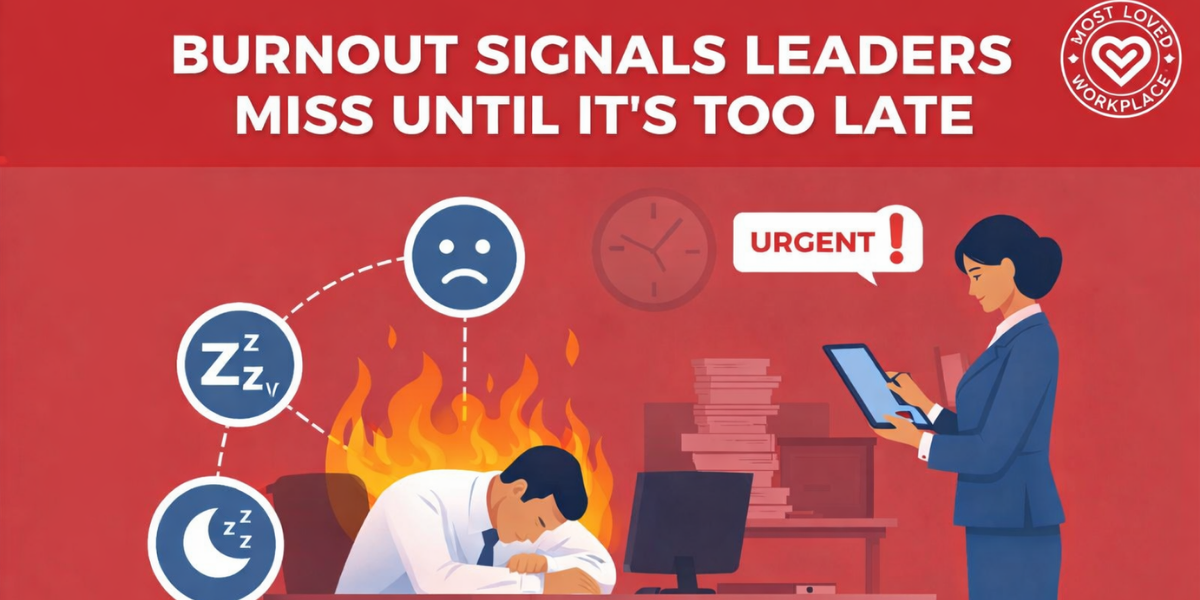
Burnout is usually diagnosed too late because leaders look for the wrong moment. They wait for a dramatic break — the resignation, the tearful meeting, the missed deadline that finally can’t be explained away.
But burnout rarely arrives as a collapse. It arrives as drift: a slow change in how a leader thinks, relates, and decides, while output still looks “acceptable.”
Burnout also hides in plain sight because it often starts in the people who can power through almost anything.
High performers have a unique ability to override warning signs, reframe exhaustion as commitment, and keep functioning long after their judgement has started to dull. The result is a dangerous lag between what’s happening internally and what the organisation can see.
The high-performer trap
Many leaders don’t miss burnout because they don’t care. They miss it because they’ve built an identity around carrying weight. When the load increases, they don’t ask “Is this sustainable?” They ask “How do I adapt?” That mindset works in short sprints. It becomes costly when the sprint becomes the job.
Harvard Business Review has made the point clearly: burnout is often a signal that the workplace conditions have become psychologically hazardous — not a personal weakness that can be fixed with more grit.
Why teams don’t label it “burnout” either
Teams rarely say, “My leader is burned out.” They say, “They’ve been tense lately,” or “Decisions are taking forever,” or “They’re just not present.” People experience burnout through behaviours and patterns, not clinical labels.
That’s why the earliest warning signs are often filed under “stress,” “pressure,” or “a tough quarter.” The organisation keeps moving. The leader keeps showing up. And the drift becomes the new normal.
The Signal Clusters Leaders Misread
Most missed signals fall into a handful of clusters. Leaders notice the surface change, but misdiagnose the cause. They attribute it to “busy season,” “a difficult employee,” or “the market,” when the more accurate explanation is that the leader’s capacity is being steadily overdrawn.
Behavioral drift (tone is the early telemetry)
One of the first signs is a shift in tone that feels out of character. The leader becomes sharper, more impatient, less curious. They interrupt more. They tolerate less ambiguity from others while carrying more ambiguity themselves.
The other side of behavioural drift is withdrawal. Fewer 1:1s. Less informal contact. Less visible coaching. They show up to meetings and get through the agenda, but the human layer disappears. Teams interpret this as “They don’t care,” even when the truth is “They don’t have margin.”
Cognitive slowdown (decision fatigue masquerading as “being busy”)
Burnout often shows up as a change in how decisions are made. Not just slower, but different. Leaders who used to make crisp calls begin delaying, revisiting, or avoiding decisions that carry irreversible consequences. They seek more input than usual, not because they’re collaborative, but because they’re unsure of their own judgement.
You also see smaller cognitive leaks: forgetting what was agreed, losing the thread in meetings, rereading the same email, needing more time to write a straightforward message. This isn’t incompetence. It’s a depleted bandwidth.
Output without impact (the productivity paradox)
One of the most deceptive signals is when hours increase but impact declines. Leaders stay online longer, respond faster, attend more meetings — yet strategic work stalls. Their calendar fills with urgent conversations and the work that requires quiet thinking gets pushed into late nights that never truly work.
This is where burnout looks like dedication from a distance. Inside the leader’s head, it feels like running hard and going nowhere. That paradox is a major warning sign: activity is replacing effectiveness.
Emotional detachment (cynicism becomes the default)
The World Health Organization describes burnout as resulting from chronic workplace stress that hasn’t been successfully managed, characterised by exhaustion, increased mental distance or cynicism, and reduced professional efficacy.
That “mental distance” piece matters. Burnout doesn’t only drain energy — it drains meaning. Leaders become less moved by wins. They stop celebrating. They start sounding cynical about initiatives they used to champion. The emotional tone becomes flatter, and humour starts leaning toward sarcasm.
Teams feel this shift quickly because leadership detachment changes the emotional climate. People stop bringing problems early. They stop sharing ideas that need nurturing. They conserve their own energy because the environment feels colder.
Physical leakage (the body keeps score first)
Before burnout becomes a leadership problem, it’s usually a health pattern. Sleep becomes lighter or shorter. The leader wakes up tired. Small illnesses linger. Headaches, muscle tension, jaw clenching, stomach issues — the body starts sending messages long before the leader decides they have a “burnout issue.”
The most dangerous part is how easy it is to normalise. Leaders often treat these symptoms as background noise: caffeine, painkillers, “I’ll catch up on sleep this weekend.” The weekend doesn’t fix a system that produces an energy deficit Monday through Friday.
The Organisational Conditions That Hide Burnout
Burnout prevention fails when it becomes a personality project. Leaders don’t need to be told to “take care of themselves” in abstract terms. They need a system that doesn’t require ongoing self-sacrifice to keep the organisation functioning.
Calendar density and the disappearance of recovery
A crowded calendar isn’t just a time problem. It’s a cognitive problem. When meetings stack with no gaps, the leader loses transition time — the mental space required to reset, reflect, and think.
The organisation often treats this as a productivity feature: full calendar equals high utilisation. In reality, it can become a sustained recovery deficit. The leader is always “on,” always context-switching, always reacting. Eventually, thinking quality drops — and teams feel it as decision inconsistency.
Span of control creep and the megamanager effect
Many leadership roles quietly expand over time. More direct reports. More cross-functional ownership. More escalations. Then someone leaves and the leader absorbs “just for now” work that becomes permanent.
This is where relationships become transactional. 1:1s turn into status checks. Coaching turns into triage. Leaders may still be working hard, but their work becomes narrower: problems, urgencies, fixes. The leadership layer that builds capability starts to disappear.
Competing priorities and unclear expectations
Nothing exhausts leaders faster than unclear priorities with real consequences. When everything is urgent, leaders are forced to constantly choose what to disappoint. That moral and cognitive burden adds up quickly.
Gallup’s research has repeatedly shown managers are experiencing high stress and burnout, often worse wellbeing and work-life balance than the people they manage — and that the trend has been worsening in recent years.
The structural issue is not just workload. It’s the combination of workload and ambiguity: shifting priorities, unclear decision rights, and constant escalation without clear boundaries.
The Missed Moment When It Was Still Easy to Fix
“Too late” often means the organisation waited until motivation disappeared. The leader still showed up, but their internal fuel was gone. The earlier opportunity is almost always visible in hindsight: a period where drift started, but the system still had flexibility.
The first “small betrayals” leaders make
Burnout accumulates through tiny tradeoffs leaders make to keep up: skipping meals, postponing exercise, cancelling thinking time, pushing conversations that require patience, staying online late because it’s the only quiet.
Each tradeoff feels rational in the moment. But collectively, they create a predictable outcome: reduced recovery, reduced clarity, reduced empathy. Those are leadership variables — not just personal wellness variables.
The two-week rule (a simple leadership framework)
Here’s a useful operator-level rule: if a signal persists for two consecutive weeks, treat it as a systems issue, not a mood.
Two weeks of poor sleep, irritability, decision avoidance, cynicism, or withdrawal is long enough to stop calling it “a rough week” and start asking what design problem is driving it. This isn’t about self-diagnosis. It’s about recognising patterns early enough to change the conditions.
What Leaders Can Measure Instead of Guess
Burnout prevention becomes practical when it becomes observable. Leaders don’t need perfect data. They need a few simple indicators that reveal whether they’re trending toward sustainable capacity or steady depletion.
Personal indicators (leader-level)
A leader can track these without turning life into a spreadsheet:
- Energy after sleep: not “How many hours?” but “Do I feel restored?”
- Decision confidence: how often do you delay decisions you’d normally make?
- Recovery time: how many days per month do you feel genuinely caught up, not just current?
If these trend negatively, the leader isn’t failing. The system is drawing too much from them without replenishment.
Team indicators (environment-level)
Teams also show burnout signals, and leaders can watch for them without surveillance:
- 1:1 quality: are conversations coaching-based or constant triage?
- After-hours urgency: does “emergency” feel normal now?
- Rework rate: are mistakes and misalignments increasing because attention is fragmented?
These indicators point to the same thing: cognitive overload, not lack of effort.
The Interventions That Actually Work (And Why)
Most burnout talk fails because it focuses on intention. Leaders already intend to rest, delegate, and set boundaries. What matters is redesign — changing the conditions that produce the energy deficit.
Redesign the calendar, not the person
If a leader’s calendar is a wall of meetings, “self-care” becomes a fantasy. The intervention is structural: reduce meeting density, protect thinking time, and build buffers between high-stakes interactions.
This isn’t about being precious. It’s about ensuring leaders can do the work only leaders can do: make clear decisions, set direction, and coach others. That work requires cognitive space, not just time.
Re-clarify priorities and decision rights
Burnout often improves quickly when leaders stop carrying decisions they shouldn’t be carrying. Clarify what is truly “must-win” in the next 30–60 days, and explicitly define decision rights so everything doesn’t route to one person.
When priorities are clear and decision ownership is distributed, urgency becomes more honest. Leaders stop paying the hidden tax of constant escalation.
Normalise early conversations (truth without threat)
Burnout gets worse when leaders feel they can’t talk about it without sounding weak. But you don’t need vulnerability theatre. You need calm, direct check-ins that focus on work design.
Useful questions don’t diagnose. They surface reality:
- “What feels heavier than it should right now?”
- “Where are we paying hidden costs in rework or urgency?”
- “What are we tolerating that is quietly draining the team?”
When someone discloses burnout, the job is not to debate it. It’s to understand it and locate root causes. HBR’s guidance on responding to an employee who says they’re burned out emphasises taking the concern seriously, understanding their experience, and identifying the drivers — not dismissing it as personal weakness.
What Most Loved Cultures Do Differently
MLW-certified cultures treat burnout differently because they treat it as a signal of system design, not a character flaw. The pattern is consistent: leaders make capacity visible, and teams don’t have to “perform wellness” to be taken seriously.
You see this across very different certified organisations — from technology companies to financial services — including names like Automattic, Inc., 8×8, Inc., Synopsys Inc., Amerant Bank, Automation Anywhere, and ABC Fitness Solutions. The common thread isn’t perks. It’s mechanisms: clarity, early feedback loops, and leadership norms that protect focus and recovery before drift becomes damage.
The most mature cultures don’t wait for crisis. They notice when tone shifts, when decision cycles slow, when urgency becomes constant — and they treat those as operational signals. Not moral ones.
Leadership takeaway
Burnout becomes “too late” when leaders wait for collapse to legitimise change. The earlier move is noticing drift, measuring it lightly, and fixing the system that produces it.
This week, make one calendar change that restores thinking time. Clarify one priority that removes unnecessary urgency. Have one honest check-in that surfaces hidden costs. Then measure the next 30 days by what actually matters: decision quality, emotional climate, and sustainable pace — not just output.
FAQs
What are the early signs of burnout in leaders?
Early signs often show up as tone changes (irritability or withdrawal), decision fatigue, lower empathy, and longer hours with less strategic progress. Physical symptoms like poor sleep and frequent minor illness often appear early too.
How do I know if I’m burned out or just stressed?
Stress can be acute and situational. Burnout tends to be chronic and comes with exhaustion, cynicism or emotional distance, and a sense of reduced effectiveness — especially when the workload pattern doesn’t change.
What are the 3 core symptoms of burnout?
The WHO describes three dimensions: energy depletion/exhaustion, increased mental distance or cynicism, and reduced professional efficacy.
Why do high performers miss burnout until it’s advanced?
Because they can function while depleted, and they often normalise the early tradeoffs as part of leadership. Burnout can look like commitment from the outside until decision quality and emotional climate degrade.
What should a leader do when an employee says they’re burned out?
Take it seriously, understand what burnout looks like for them, and identify the root causes in workload, expectations, and support. Avoid debating whether they “should” feel that way — focus on drivers and changes.
How can leaders prevent burnout on their team without lowering standards?
Treat burnout as a design problem: clarify priorities, set decision rights, reduce constant escalation, protect focus time, and build recovery into the operating rhythm. High standards require sustainable capacity.
How long does burnout recovery take?
It varies. The key is that recovery usually requires changing the conditions that created the chronic stress — not only taking a short break and returning to the same design.
What’s a fast change that reduces burnout risk quickly?
Reduce meeting density and add protected thinking time for leaders and key operators. When cognitive space returns, decision quality improves quickly — and the emotional temperature drops.

Louis Carter is the founder and CEO of Best Practice Institute, Most Loved Workplace, and Results-Based Culture. Author of In Great Company, Change Champions Field Guide, and Best Practices in Talent Management, as well as a series of Leadership Development books. He is a trusted strategic advisor and coach to CEOs, CHROs, and leaders of mid-sized to F500 companies – enabling change and steering employer brand development together with highly effective teams, leaders, and organizations as a whole.


0 Comments